2011년 1월 23일 일요일

Korean Buddhism / Stupas or Pagodas


Stupas or Pagodas
A stupa is a memorial -- a symbol of the Buddha, as the principle of enlightenment, pointing indirectly to both the teacher and his teachings.
It is specifically a reminder of his final passing of the Buddha since sometimes it enshrines relics. In the early days, before Buddha statues were enshrined in temple halls, a stupa was the object of worship.
Traditionally, stupas are built in the central area of temples. There are two types of relics enshrined in a stupa: Buddha-sari (physical relics) and Dharma-sari or sutras (the Buddha's teachings). On the surface of a stupa you will sometimes find carved figures of the Buddha, bodhisattvas or congregated guardians. Occasionally, wind-chimes hang from the corners of its roof and make beautiful sounds when a breeze blows.
A pagoda is the general term in English for a tiered tower with multiple eaves common to Nepal, China, Korea, Japan and other parts of Asia.
Pagodas in Korea were made of wood, earth, brick, stone or other materials.

Wooden Pagodas
Ssangbongsa Daeungjeon 
Ever since Buddhism was first introduced to Korea in the late 4th century, the custom of building wooden pagodas became popular. Until recently, there were only two wooden pagodas remaining, preserved in Korea as cultural heritage objects: the Palsangjeon at the Beopjusa Temple and the Daeungjeon at the Ssangbongsa Temple, both used as Main Halls.

Palsangjeon, a five-story wooden pagoda, at Beopjusa Temple
Palsangjeon, literally, means hall of eight pictures. These eight pictures are of the acts performed by the Buddha in order to save people. The existing Palsangjeon is a square, wooden building with a five-tiered roof, 22.7 meters in height, with a surface area of eight square meters. It stands on a stone platform with an entrance at each of the cardinal directions. There are several structural characteristics to this Pagoda. For example, it has a central pillar running up the middle of the building, an inner frame of four stories in height with a log structure on top, and an outer frame ending at the third story.

The inside of the building is made up of three parts: the place to store the relics of the Buddha, the place to enshrine the statue of the Buddha and Palsangdo, the pictures of the eight scenes and a place for paying homage to Buddha.
All historical records of the Palsangjeon have been lost. Two inscriptions, however, were discovered during major repair work done in 1968. The dates of the inauguration of this building are on the relic container underneath the central pillar, and the other is on the main ridge of the roof. According to the inscription records, the relic was enshrined in 1605 and the roof frame was completed in 1626. The construction period lasted twenty-one years.

Stone Pagodas
There are many stone pagoda remains preserved in Korea. The first stone pagodas were built in the middle of the 6th century after two centuries of building wooden pagodas. The Silla stone pagodas and those of Baekje origin are distinguishable due to the techniques used and the design. They differ in the material used and the tectonic form adopted. In Silla, granite was used and the design was taken from wooden pagodas. In Baekje, andesite alone or mixed with granite was used and the design following this was brick-style masonry. A pagoda is basically divided into three parts: its foundation, body and finial.
Jeongnimsa Five-story Pagoda
The five-story stone pagoda on the site of Jeongnimsa Temple 
The five-story stone pagoda at Jeongnimsa Temple was built during the Baekje Period (18B.C. –A.D. 660) along with the stone pagoda on the site of Mireuksa Temple in Iksan-si City. Believed to date back to the early seventh century, it is one of the oldest and most exemplary of the many stone pagodas still existing today.

The five-story pagoda body stands on a single narrow, low pedestal. Pillar stones are fixed in the middle and on the corners of each side of the pedestal. There are pillars at each corner of the body on each story. The roof stones are thin, wide and raised at the ends of the eaves to make them look elegant. From all this, we can guess that this pagoda was built following the design of a wooden building – a main characteristic of this pagoda. The whole figure is very majestic and beautiful and it is particularly prized because it is one of the two remaining stone pagodas from Baekje Period.
Gameunsa Twin Pagodas 
The twin three-story stone pagodas on the site of Gameunsa Temple 
These magnificent twin pagodas, built in the 7th century, are the biggest existing pagodas of their kind in the Gyeongju area. A pair of pagodas of the same size and style is found on the site of Gameunsa Temple. Traditionally, there were two types of temple layout. One was with one Main Hall and one pagoda. The other was first introduced at Gameunsa Temple and consists of twin pagodas for one Main Hall.
The twin pagodas have a three-story body on a two-tier foundation, creating an impression of stability and height. This impression is further increased by the main body of the first story, which is much taller than those of the other stories and a long, piercing mast as the finial. Something to take special notice of is each portion of the two pagodas is comprised of lots of stone pieces instead of a single stone. The pagodas have a carefully balanced ratio of one part to the next, which further increases the impression of dignity and magnificence. When the west pagoda was repaired in 1960, a royal palanquin-shaped relic container was retrieved from the third story.
Of all the pagodas in Korea, the two most representative pagodas at the same site are: the Pagoda of Many Gems and the Three-storey stone Pagoda of Sakyamuni in the world of Humanity at Bulguksa Temple. The reason for building the two pagodas at the same site is to follow the statement found in the Lotus Sutra that the Buddha of the past --Dabo -- is standing beside the Buddha of the present -- Sakyamuni -- to witness the Buddha’s teachings.
Bulguksa Dabotap
The Pagoda of Many Gems at Bulguksa (다보탑, Dabotap) 
The Dabotap stands to the right as one faces the Main Hall of the world of Humanity at Bulguksa -- the Temple of Buddha Land. "Dabo" means "many Gems," and the Dabotap is dedicated to the Dabo Yorae -- the Buddha of Many Gems. Dabo was a disciple of Sakyamuni who eventually achieved enlightenment. Historically, there are records of a Dabotap being built in China in 732; the pagoda at Bulguksa was built less than twenty years later.

The three-story stone pagoda of Sakyamuni at Bulguksa (석가탑, Seokgatap) 
The 8.2 meter high three-story pagoda is considered Korea’s most common stone pagoda and is even pictured on the 10 won coin. Indeed, along with the twin pagodas at Gameunsa, Seokgatap follows the "golden mean" in Silla pagoda architecture. During the restoration work in 1966, a wood-block printing plate containing a section of the Dharani Sutra was found in Seokgatap. This is considered to be the world's oldest surviving wood-block printing plate.
The brick-shaped three-story stone pagoda on the site of Bunhwangsa Temple (모전석탑, Mojeonseoktap) 
The pagoda of Bunhwangsa Temple is the oldest remaining stone pagoda of Silla origin. It was built in the 7th century. It is a stone masonry pagoda built by piling stones that were trimmed with charcoal-grey andesite. cut crudely into bricks. There is a record that the pagoda was originally nine-stories high, but today only three stories are left. Together with the nine-story wooden pagoda of Hwangryongsa Temple, it was built to supplicate the Buddha’s protection of the nation and the Queen’s reign.
This pagoda stands on a square single-story platform made of natural stones with a granite lion at each of the four corners of the platform. The pagoda body is presently only three-stories high and has been made by piling small brick-shaped stones trimmed from charcoal-grey andesite. Compared with the first-story core, it is prominently reduced in size from the second story on. There is a doorway complete with a stone lintel, threshold, doorjamb and two doors on each side of the first level. A pair of Vajrapani, guardians of Buddhism, stands sentinel at each doorway. The roof stone is like a brick pagoda that has staircase-shaped stories at both the upper and the lower part. Only the upper part of the three-story roof stone is square pillar-shaped. There are lotus flowers in full-bloom carved in the granite.
Gyeongcheonsa Pagoda
The ten-story marble pagoda of Gyeongcheonsa Temple 
This pagoda was taken to Japan during the Japanese occupation period of Korea and relocated to the Gyeongbokgung Palace in 1960.
According to an inscription on the first story, this pagoda was erected in the 14th century. This 13 meter-high, ten-story pagoda is unusually made of marble, distinguishing itself from other pagodas of Goryeo origin. The three-tiered platform holds the first three stories of the pagoda. They are all cross-shaped with each part going out in the four directions. The next seven stories are square. Buddhas, Bodhisattvas, and flower designs are sculptured on them. From the fourth story up, each story has railings and hipped-and-gabled roofs, suggestive of a wooden building with a tiled roof. The eaves of the roofs appear to have been influenced by the wooden architecture of the period, which makes them an important object of study for understanding the architecture of that time period.

Korean Food / Sol-long-tang


Sol-long-tang
Rice & Beef Noodle Soup
설렁탕

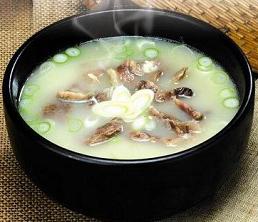
Sollongtang is rice beef noodle soup seasoned with sesame seeds, salt, pepper, scallions, and sesame oil. This dish has long been favored by Koreans as one of the staples of Korean cuisine and has been undisputedly favored as a primal dish common to most cultures. It is served with rice in which the rice may be directly added to the soup. The meal is also accompanied by numerous side dishes, including kimchi or kkakdugi. As butter is to bread, kimchi or kkakdugi is an inseparable side dish for this meal.
Fact: Sollongtang has been known to be one of the best remedy for curing a hangover in the Korean culture.
Recommended Restaurants
Recipe Ingredients
  • ½ lb beef rib steak
  • 1⅓ lb shank of beef
  • ½ whole Korean radish
  • ¼ lb Chinese noodles
  • 1 large green onion
  • 5 cloves garlic
  • Salt, black pepper
  • Very large pot with cover
Cooking Directions
  1. Cut the beef into pieces and divide the radish into two pieces. Boil the beef and radish in 30 cups of water. Lower the heat and simmer for 1 hour till the meat is very tender.
  2. Take the meat and radish out of the broth. Cool the broth and cut off the excess fat. Slice the meat thinly into small size. Slice the radish into pieces 1/8" thick.
  3. Add the meat, radish and crushed garlic to the broth. Then boil again.
  4. Place noodles. Originally, you put buckwheat noodles in the soup. Nowadays, you can put other thin noodles such as Chinese noodles.
  5. Cut large green onion into rings. Add salt, black pepper, and green onion and check seasoning by salt before serving.
PRINT-FRIENDLY
Featured Items - Click & Shop Online


Korean Food / Kim-chi


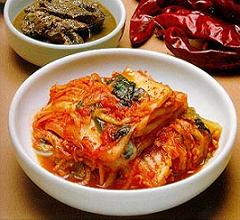
Kimchi
Kim-chi
Fermented Cabbage
김치
Kimchi is a traditional Korean dish consisting of fermented chili peppers and vegetables, usually based on cabbage. It is suspected that the name kimchi originated from shimchae (salting of vegetable) which went through some phonetic changes: shimchae > dimchae > kimchae >kimchi.
Common ingredients include Chinese cabbage, radish, garlic, red pepper, spring onion, ginger, salt, and sugar. While Kimchi is generally identified internationally as Chinese cabbage fermented with a mixture of red pepper, garlic, ginger, and salted fish sauce, several types of kimchi exists, including regional and seasonal variations. There are variants, includingkkakdugi, based on radish and containing no cabbage.
Kimchi has been cited by Health Magazine as one of the world's five "healthiest foods", with the claim that it is rich in vitamins, aids digestion, and may even prevent cancer. The health properties of kimchi are due to a variety of factors. It is usually made with cabbage, onions, and garlic, all of which have well-known health benefits. Kinchi also has active and beneficial bacterial cultures, like yogurt. Lastly, kimchi contains liberal quantities of hot pepper, which has been suggested to have health benefits as well.
The best tasting kimchi is stored in room temperature for an average of six months to reach its full flavor.  It is a popular side dish but is also often used as an ingredient in cooking other popular Korean dish, including kimchi chigae (kimchi soup) and kimchi bokumbop (kimchi fried rice).
Fun fact: Like the McDonald’s University of Hamburgers in Illinois, US, there is a Kimchi Research Institute located in Pusan National University, South Korea.
Buy kimchi online: New York Kimchi
Featured Items - Click & Shop Online

2011년 1월 22일 토요일

The Way follows the way things are 道法自然


有物混成、先天地生。寂兮寥兮。獨立不改、周行而不殆。可以爲天下母。吾不知其名。字之曰道。強爲之名曰大。大曰逝。逝曰遠。遠曰反。故道大。天大。地 大。人亦大。域中有四大、而人居其一焉。人法地 地法天 天法道 道法自然。
There is something that is perfect in its disorder
Which is born before Heaven and Earth.

So silent and desolate! It establishes itself without renewal.
Functions universally without lapse.
We can regard it as the Mother of Everything.

I don't know its name.

Hence, when forced to name it, I call it "Way."
When forced to categorize it, I call it "great."

Greatness entails transcendence.
Transcendence entails going-far.
Going-far entails return.

Hence, the Way is great, Heaven is great, the Earth is great
And the human is also great.

Within our realm there are four greatnesses and the human being is one of them.

Human beings follow the Earth.
Earth follows Heaven
Heaven follows the Way
The Way follows the way things are.


현일선생 

도법자연
이말은 도덕경 25장에 나오는 말이다.
도가 끝이 아니라 자연이 끝인데 법法의 해석을 어떻게 해야 할까?
대개는 본받는다고 해석한다. 이전에 '인법천 천법도' 하면서 사람은 하늘을 본받고 하늘은 도를 본받는다고 하면서 해석하는 것같다.
그럼 사람이 본받는 하늘이란 뭘까?
청명한 저 위의 푸른 하늘을 말하는건 아닐 것이다.
난 서양의 자연과학이 오기전엔 푸른 하늘의 허공적인 관념은 우리에게 없었다고 생각한다.
내 인생의 그 질곡과 기뿜과 고통과 희열같은 직접적 삶의 근거로서 운명처럼 생각하던 그 실제라고 하늘을 평소에 보면서 생각했다고 본다.
이것이 과학에 의해 단순한 공간적 무의미한 현상으로 지금의 푸른 하늘이 되었다.

이게 과거엔 내가 살아간다고 생각하지 않는다. 감정이 있고 하고싶은 것이 있지만 이건 내 욕심이 아니다.
내가 그렇게 살 수 밖에 없는 것으로 하늘이 하는 것이다.
내가 사는 것이 아니라 하늘이 사는 것이다.
내가 욕망하는 것이 아니라 하늘이 욕망하는 것이다.


그런데 이런 우리의 상위에서 근거로 있는 하늘위에 도가 있다고 하는 것은 이도가 단순한 상위가 아니라 하늘과 나의연결로서 이어주는 그 메타하늘이 된다. 즉 품격이라는 것이다. 나의 하늘과 하늘의 하늘로서 그 하늘이 도라는 의미이다.
하늘도 하늘이 하는 것이 아니라 도가 하는 것이다.
하늘이 사는게 아니라 도가 사는 것이다.
하늘이 욕망하는게 아니라 도가 욕망하는 것이다.

이게 나중에 오면 음양오행이 있고 그 위에 태극이, 또 무극이 되는 식으로 말이 바뀐다. 같은 공식이다.
근데 도덕경에는 자연이라는 것을 하나 더 말한다.
그럼 자연이 뭐길래 도가 본받아야 하는 걸까?
어디선 이 자연이 '스스로 그러함'이라서 의미없는 의미라는 것이라고 하는듯하다.
줄이면 '도가 그러하다'고 하는 걸까?
아마 이런식으로 이해하려는 것이 많을 것이다. '스스로 그러하다.' 그럴듯하다.
이게 '위무위'나 하는 식으로 '함이 없이 한다'는 것처럼도 보이고 해서 전체적으로 일관성이 있어 보이는데,

난 하늘이 이미 법이되는 의미가 잇고 도가 이미 스스로 그러하다는 의미가 있는 것으로 본다.
내 인생이 어쩔 수 없는 힘의 흐름에 따를 수 밖에 없다는 것이 있고 그것을 하늘로 보면서 하늘도 그렇게 될 수밖에 없는 것으로 도를 본다. 또 도 마저도 어쩔수 없는 것으로 자연이라고 하는 것이다.
이러면 이 자연이라는것은 이미 나나 하늘이나 도나 다 같이 자연이라는 것이 된다.
가면 멀어지고 멀어지면 돌아오는데 나에게서 간것이 나에게로 돌아와서 내가 자연이 된다.
난 이미 자연을 본받고 있었다.

그럼 도는 도가 사는게 아니라 자연이 사는 것인가? 이건 아니다. 이게 자연의 해석의 어려움이다.
도가 스스로 그러하는 게 아니라 우리 모두가 도이전에 하늘이 하늘 이전에 내가 나 이전에 도가 도 이전에 하늘이 하늘 이전에 내가 이렇게 서로서로 먹히고 먹히며 이미 그렇게 하고 있었고 누가 사는지 누가 욕망하는지 그걸 알 수가 없다. 다이거나 아무도 아니거나 때론 하늘이 때론 내가 때론 도가 욕망하는 그렇고 그런 것이다.


도는 보편적인 현상을 말하는 것으로 이해하고 자연은 개체적인 현상으로 이해한다. 이 세상이나 전체나 하늘이나 천지나 우주나 모든 세계전체를 하나의 개체로보면 이것도 자연이고 나도 개체이니 자연이다.
도도 개체이니 자연이다.
그래서 자연은 나도 하늘도 도도 일체세계도 모두 자연이다.

도법자연이라고 하면 나나 도나 모두가 이미 그렇게 하고 있다는 의미로, 나 오직 나이다.
나는 나의 의식이 아니라 하늘과 도와 일체세계의 모든 현상이 나다.

덧붙이면 나와 하늘과 도는 삼각형으로 항상 서로를 지켜보고 있는 것이다.
그래서 몸의 구성엔 하늘과 도도 포함되어 있다고 할 수 있다.
의식과 마하와 마가 나와 하늘과 도의 공식과 비슷하다.
내가 있고 나를 보는 자가 있고 그 보는 것을 보는 자가 있다.
이런 것은 저절로 그러하다.
[출처] 도법자연|작성자 현일

2011년 1월 15일 토요일

부벽루(浮碧樓) - 이색(李穡)


昨過永明寺(작과영명사)   어제 영명사를 지나다가

暫登浮碧樓(잠등부벽루)   잠시 부벽루에 오르니

城空一片月(성공일편월)   성은 비어 있고 하늘엔 조각달

石老雲千秋(석노운천추)   돌은 오래 묵고 구름은 천년을 떠도네

麟馬去不返(인마거불반)   기린마(동명왕이 타던 말)는 한 번 떠나 돌아오지 않고

天孫何處遊(천손하처유)   천손(天孫, 동명왕)은 지금 어느 곳에 노니는가

長嘯倚風磴(장소의풍등)   길게 휘파람 불며 바람 부는 비탈에 서니

山靑江自流(산청강자류)   산은 푸르고 강물은 절로 흐르네


김시습의 《금오신화》 '취유부벽정기'에서는 영명사가 동명왕의 구제궁(九梯宮)이라고 소개했는데, 그 이름의 뜻은 사다리 9개를 이은 것과 건물의 크기가 같다는 말이다. 옆에는 기린굴(麒麟窟)이 있는데, 평양 지역의 전승에 따르면 천손(天孫) 동명왕이 이 동굴에서 기린을 길렀으며, 죽을 때에는 기린을 타고 조천석(朝天石)을 밟고 하늘로 올라서 다시는 돌아오지 않았다는 이야기가 전한다.